Getting Poorer in Silence
For two decades the loudest voices in Australian politics have belonged to a certain group, not the people who simply earn a wage.

In May, the federal budget did something Australian budgets almost never do. It touched the tax concessions that protect wealth. Negative gearing was narrowed to new homes. The capital gains discount on established dwellings was trimmed. The government argued the measures were modest. The reaction was not.
Within hours a campaign was running across every channel that matters. Op-eds warned of an assault on aspiration. Talkback lit up. The feeds filled with memes about the death of the Australian dream. Individual cases were paraded, the nurse with one investment property, the tradesman with a family trust, the self-funded retiree watching his portfolio. Each story was real. Each deserved a hearing, but they have always been given a hearing.
But step back and the arithmetic does not hold. The people who own multiple properties, who hold trusts, who live off capital gains, are a small fraction of the country. More than eight in ten working Australians earn a wage or a salary; fewer than one in five run a business of their own. Around one in five households owns any property beyond the one it lives in, and the number holding several, or living off the gains, is smaller again. Their volume and granted attention on the national stage bears no relation to their share of the population. They are loud because they are organised, connected and accustomed to being heard. The salaried Australian, the person who earns a wage, owns no asset beyond a mortgage, and has watched their living standard fall for three years, barely registered in the same week.
This is not an accident. It is the structure of wealth and power in this country and who gets to speak and who does not.
Why the elite speak about themselves
The people who set the terms of national debate are drawn, overwhelmingly, from the classes that own assets or hold credentials. The famous, columnists, advisers, think-tank fellows, the heads of advocacy groups, they tend to own property, carry degrees, and move in circles where capital gains and trusts are ordinary dinner-table concerns. They write about what they know and what they fear. A change to the capital gains discount is, for a great many of them, a personal threat. A thirty per cent rent rise on food for an aged-care worker in the outer suburbs is, to the same people, an abstraction.
There is also the plain matter of organisation. Property investors have peak bodies. Retirees have lobbies. Industries have associations with media budgets and a standing line to the press gallery. There is no peak body for the person on a salary. No one convenes a press conference on behalf of the registered nurse or the regional maintenance supervisor (except unions).
Thomas Piketty gave this arrangement a name. In his long history of political cleavages he describes the modern Western party system as a contest between two elites. On one side, the Merchant Right, the party of business, wealth and the high-income professional. On the other, what he calls the Brahmin Left, the party of the educated, the credentialed, the culturally confident. The right speaks for capital. The left speaks for the diploma. Between them, the person who holds neither significant capital nor a degree-based identity is left without a home.
The left looked away too
It would be easy to read this as a charge against the right alone. It is not. The same blindness runs through the left, and the past three years have made it plain.
From late 2023, large parts of the Australian left were consumed by Gaza. The cause was serious. The suffering was real, and the moral urgency was understandable. But consider what was happening at home in exactly the same period. Real household disposable income was falling at a rate not seen anywhere else in the developed world. Australians were getting materially poorer, faster than the people of any other wealthy nation. Rents were climbing by double digits. Hundreds of thousands of mortgages were rolling off fixed terms into a wall of higher rates.
There was no equivalent mobilisation for any of that. No marches for the salaried. No encampments for the renter watching half her pay disappear into a landlord’s mortgage. The Brahmin Left’s moral economy is organised around identity and global justice, and it is sincere in that. But it does not get out of bed for the wage. The collapse in living standards was the largest political fact of the period, and the side of politics that claims to speak for working people was facing the other way.
What the numbers say
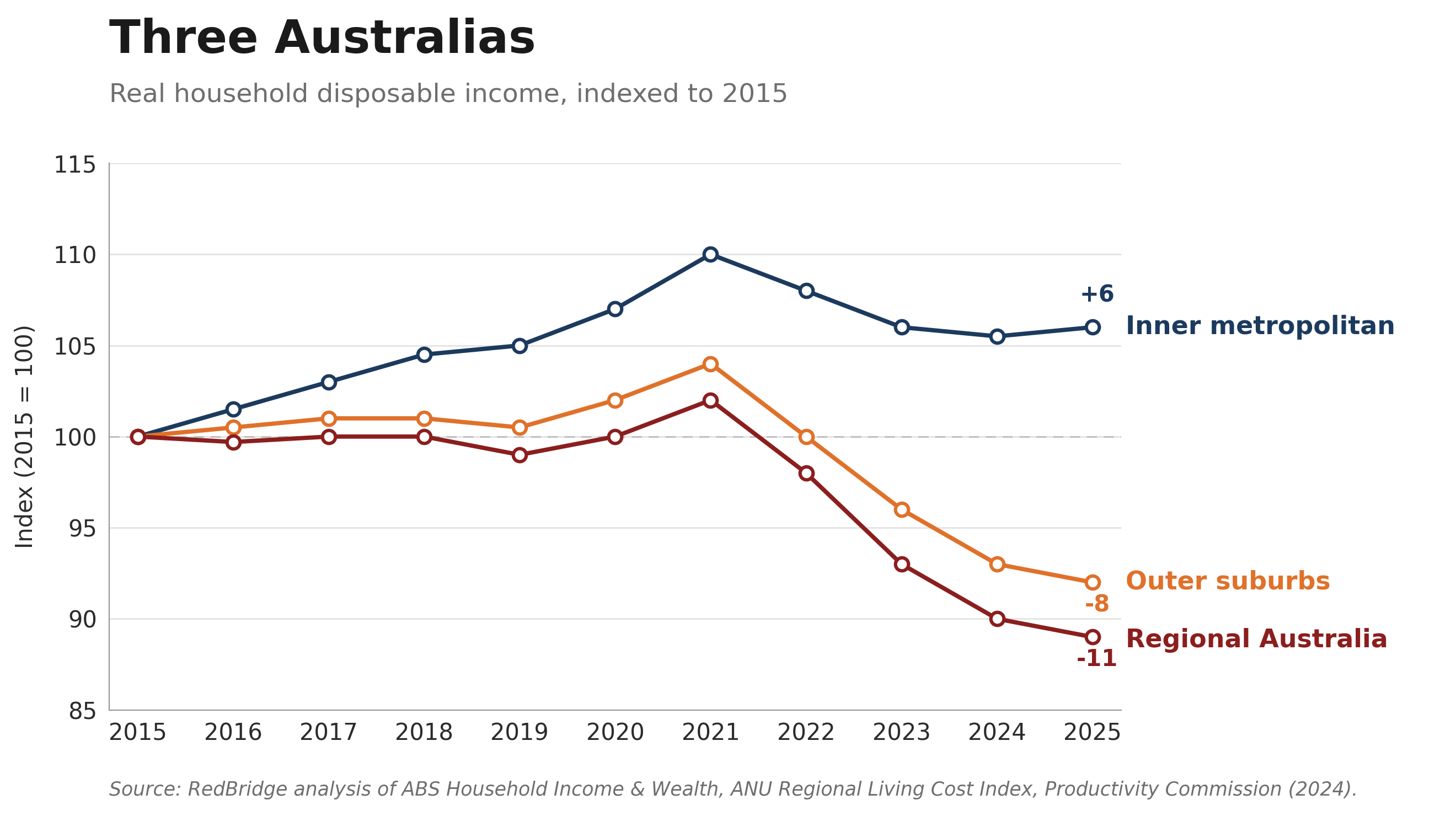
The figures are not in dispute. Australian real per capita household disposable income fell by around eight per cent from its mid-2022 peak, the steepest decline on record, and the largest in the OECD. Measured from just before the pandemic, Australian disposable incomes have risen by roughly one-tenth of one per cent. Across the OECD as a whole they rose more than nine per cent over the same window. We did not merely fall behind. We went backwards while comparable nations went forward.
The causes are familiar. The Reserve Bank lifted the cash rate by 425 basis points across thirteen increases from May 2022. Australia carries one of the world’s highest shares of borrowers on variable-rate mortgages, so those rises landed faster and harder here than almost anywhere. Bracket creep quietly raised the tax take year after year. Wages, when they finally moved, moved late (again, only because unions campaigned for it). And the pain was not spread evenly. It fell hardest outside the big cities, and hardest of all in the outer suburbs and the regions, the places furthest from the asset wealth concentrated along the harbour and the inner ring.
And the people going backwards are increasingly young, and increasingly renting. Roughly three in ten households now rent, but among the under-forties the figure is far higher and still climbing. Barely half of Australians aged twenty-five to thirty-nine own a home, against two-thirds of the Baby Boomers at the same age. For those in their late twenties, ownership has fallen from one in two in the early 1970s to about one in three today. A wage no longer buys a foothold. It buys rent, and the rent keeps rising.
Two people you will never see trend
Consider two of them. Neither is famous. Neither will become a meme.
The first is a registered nurse, thirty-four, the daughter of migrants, working shifts at a public hospital in Melbourne’s outer north. She earns a little under ninety thousand dollars, a real salary, a skilled job, the kind of work the country could not run for a single day without. She rents, because the deposit on anything within an hour of her ward is now beyond her, and moves further beyond her each year. She still carries the HECS debt from the degree that qualified her. There is a car loan, because there is no train that is safe during her night shifts. Her rent has risen by more than a third in three years; her pay has not. She did everything that was asked of her generation, studied, trained, took an essential job and she is going backwards. There will be no campaign on her behalf.
The second is a maintenance supervisor, fifty-one, at a food-processing plant in regional NSW, salaried, mid-career, the man who keeps a town’s largest employer running. In 2021 he and his wife fixed their mortgage a little above two per cent and felt, for the first time, secure. When the fixed term ended they rolled onto a rate three times higher. Their repayments rose by more than a thousand dollars a month, on a wage that did not move at all. He is not poor on paper. He owns a house. But he cannot feed the mortgage on the house he owns, and there is no concession, no lobby, no meme campaign for him either. He is the regional line on that chart, made into a person.
These two are the salaried Australia. Between them they are most of the country. And in the week the budget tried, however modestly, to shift the balance back towards them, the airwaves belonged to the people they will never become.
The invisibility is old
It has a history, and the history is instructive.
In August 2001 the Tampa stood off our waters, and a government discovered it could win an election by pointing outward, at the boats, rather than inward, at wages and security. It worked. And it taught both sides of politics a durable lesson: that the cheapest way to hold power is to fight over who belongs, not over who is getting poorer. The long decline in the economic security of the salaried Australian did not begin when Tampa arrived. It began, in part, with the discovery that their material conditions could be safely ignored, so long as the noise on subject matter that mattered more to the material elite, was loud enough to drown them out.
The political class took that lesson and built two decades on it. Having learned it need not contest the material conditions of ordinary people, it turned its energy inward, on itself. Between 2010 and 2018 the country ran through prime ministers at a rate without modern precedent, Rudd, then Gillard, then Rudd again, then Abbott, then Turnbull, then Morrison, five people and six prime ministerships in eight years. Most were installed and removed not by voters but by their own colleagues, in a party room, overnight. The energy went into the spill, the challenge, the count. Careers were made and unmade in Canberra while, beyond it, rents climbed and wages stalled and the salaried Australian waited for a conversation that never came. The theatre was riveting. It was also entirely about the people on the stage, and never about the people in the seats.
They are leaving
Here is what the elite, on both sides, have missed while they argued among themselves. The salaried are defecting.
The person without capital and without a credential-based identity, the one Piketty described as homeless in the modern party system, does not stay homeless forever. In Australia the destination has a name. One Nation is collecting the salaried voter who has decided that neither the party of capital nor the party of the diploma is speaking to them. It offers them, at the very least, the experience of being addressed. That its answers are mostly aimed at the wrong targets is, for now, beside the point. It is the only party that bothers to knock on the door.
Labor still holds the remainder. It holds the diverse salaried, the nurse in Melbourne’s north among them and the professional salaried who have not yet given up. But it holds them conditionally, on borrowed time, and partly on the strength of having finally, in this budget, taken their side.
Because that is what the budget did, for the first time in a very long time. For all the fury of the response, the memes, the op-eds, the parade of investment-property hardship, the measures pointed in a genuinely new direction. They moved a little of the tax advantage away from the people who own the assets and towards the people who earn the wage. The loudness of the backlash is the best evidence of how rare that is. They were not angry because they were being destroyed. They were angry because, for once, they were not being prioritised.
The silent Australians are still here. They earn a salary, they raise children, they keep the wards and the plants and the towns running, and they have been getting poorer for years while the national conversation was about something else. They were never quiet by choice. They were drowned out. The party that learns to hear them, plainly, without the meme war, without the moral theatre, will inherit the country. The first budget that took their side is a beginning. Whether anyone has the nerve to follow it is the only question in Australian politics that now matters.