
Frustration is Not Loyalty
The number is not the story

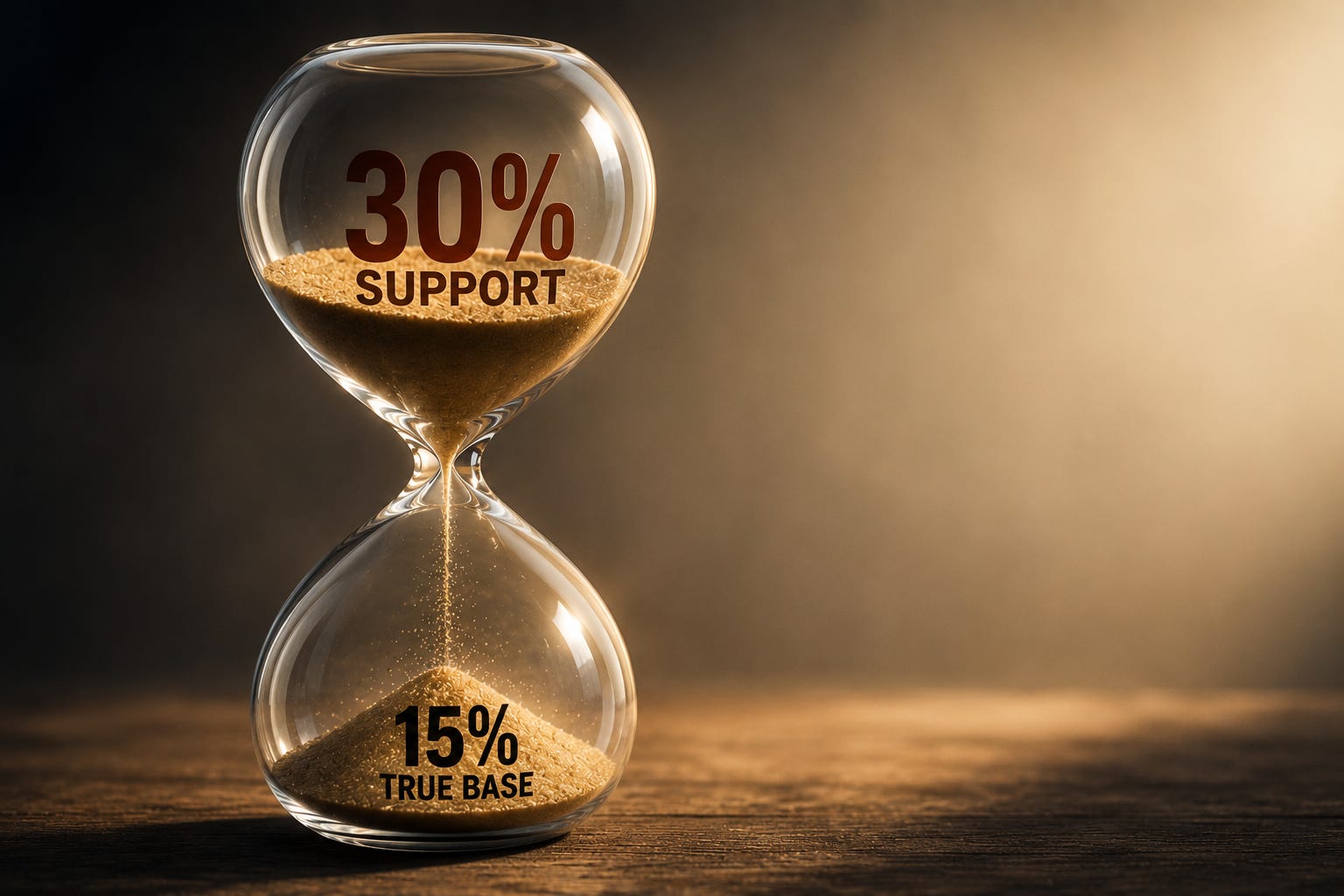
A poll is a photograph. It captures a moment. It tells you nothing about what created that picture and what may change in the weeks and months.
Yet much of the reporting on Australian polling treats the photograph as the film. A party sits on 30 per cent, so 30 per cent becomes its destiny. Headlines are written and seat counts are extrapolated.
One Nation’s current position is the best example of why this is false economy.
Averaged across published polls, One Nation sits at roughly 30 per cent of the national primary vote. Reported on its own, that number reads as super strength. A party that spent two decades on the fringe now polling ahead of the Coalition. A historic realignment, locked in.
Some of it is real. But a large share of that 30 per cent is not a rock solid vote or conviction. It is a mood.
This is the part polling cannot measure well. Survey instruments are good at recording a choice. They are poor at recording why the choice was made, and how firmly it is held. And what our qualitative work keeps telling us is that a significant portion of One Nation’s vote is not a vote for One Nation at all. It is a vote against the entire political system. Frustration, parked somewhere, against the established order.
However, frustration is not loyalty, and it is certainly prone to shifts. Hence, the critical question for anyone reading these numbers is a simple one: does that support hold as an election gets closer, when the choice stops being an expression and starts being a decision?
Victoria is about to give us an answer.
The state goes to the polls in November. In our latest poll for the Australian Financial Review, One Nation’s Victorian support has fallen five points, down to 22 per cent. Most of that movement has gone to the Coalition.
The change agent opportunity
Here sits a hypothesis worth testing. As election day approaches, the frustrated voters who abandoned the Coalition begin to drift back, because they conclude the Coalition is the real change agent.
Understand the psychology of these voters and the logic becomes obvious. They did not park their vote with One Nation because they read its policy platform. Most could not name three of its policies. They parked it there because it was the loudest available signal of rejection. The protest was the message they wanted everyone to hear. It was aimed at both major parties, but in Victoria it carries a specific target: a government they believe has stopped listening to people like them, one that has been riddled with some many scandals that you could be forgiven for mistaking it for the Jefferey Archer and Jonathan Aitken show.
That is the crucial detail the topline hides. For a large share of these voters, the underlying objective was never to elect One Nation. It was to remove a government. One Nation was simply the sharpest instrument lying around at the time.
Which means the Coalition does not need to win an argument with One Nation. It needs to win an argument about arithmetic. In a lower house contest, a protest vote that cannot form government is a protest that changes nothing. The government survives it. As election day approaches and the contest turns from expression to decision, this logic starts doing the Coalition’s work for it. If you want them gone, you vote for the party that can actually replace them.
Our Victorian polling suggests the conditions for this are already forming. The Coalition leads the primary vote. Brad Battin’s predecessor problem does not exist for Jess Wilson, who enters the contest with a net favourability of plus 13, unusually strong for an opposition leader, and majority hard name recognition. Meanwhile Pauline Hanson sits at net minus 17 with Victorians, with four in ten holding a very unfavourable view. A protest vehicle whose national figurehead is deeply unpopular in the state is a vehicle voters will exit without much grief. This revelation also suggests that we may see more decline as we get closer to the election.
But the Coalition’s opportunity comes with a trap, and it is one they keep walking into at a national level. The temptation is to chase these voters on One Nation’s terms. To mimic the anger, borrow the rhetoric, fight on the terrain of grievance. That approach fails, because on the terrain of grievance One Nation is the authentic product and the Coalition is the imitation. Voters can tell.
The change agent play is different. It does not ask these voters to stop being angry. It validates the anger and then redirects it toward something usable: a government that can be removed, services that can be fixed, a state that can be run properly. It says, in effect, your frustration is legitimate, and here is the one lever that actually pulls. The Coalition wins these voters back not by out-shouting One Nation but by being the credible instrument of the change One Nation can only gesture at.
That word, credible, is doing all the work. The change agent position is not claimed through advertising. It is conceded by voters, and only when the alternative government looks like a government. Discipline, a small number of concrete commitments, a leader who reads as competent rather than furious. If the Coalition holds that shape through to November, the drift back becomes a flow.
Labor’s harder road
Labor faces the same task from the other direction, and a much harder version of it.
A sizeable chunk of Labor’s former vote is also sitting on One Nation. These are outer suburban and regional voters, many of them from families that voted Labor for generations. They did not leave over ideology. They left over cost of living, over services, over the accumulating sense that the party stopped seeing them. Labor needs a large share of them back to survive.
But look at the asymmetry. The Coalition can offer its defectors hope. Come back and you get the change you wanted. Labor cannot make that offer. It is the government. Change is the thing being demanded of it, not the thing it can promise. So the motivation Labor must build is not hope. It is fear.
Fear of what a vote parked on One Nation actually produces. Fear that a protest in the wrong seat elects the other side. Fear of what happens to wages, to services, to the things these voters still associate with Labor, under a government they did not intend to install. Fear campaigns have worked for Labor before. Medicare has won it elections.
The problem is that fear only works when the messenger is trusted, and these voters left precisely because the trust broke. A warning from a party you feel abandoned by does not land as protection. It lands as another demand. There is a version of this campaign where every Labor ad about the dangers of a protest vote simply confirms what the defector already believes: that the party talks at them, not to them.
Fear also asks for discipline that governments under pressure rarely have. It requires a single, sustained, concrete story about consequence. A government fighting internal fires, carrying an unpopular record and a new leader still introducing himself to the electorate will struggle to hold that story for twelve weeks. Hope forgives a messy campaign. Fear does not.
So Labor’s task is not impossible, but it is second order. The Coalition is pulling on an open door, whilst Labor is pushing on a closed one.
What 15 per cent looks like
Now consider what happens if both parties succeed, even partially.
One Nation could easily finish on 15 per cent. And at 15 per cent, spread thinly across the state, it wins hardly anything in the lower house. The party that spent a year dominating the published polls ends election night with a pile of votes and almost no seats to show for it.
That outcome is entirely possible because of something the topline number hides. A large chunk of One Nation’s vote is rented, not owned. A point we at redBridge have made many times. The true base, the voters who are with the party out of belief rather than grievance, sits at around 15 per cent. Everything above that line is on loan from the major parties, and loans get called in when the contest gets real.
None of this means One Nation is finished, or that the anger driving its rise has gone anywhere. The conditions that produced this vote are structural and they are not improving. If the major parties win these voters back in November and then fail them again, the loan gets extended, and next time on worse terms.
But it does mean the 30 per cent should never have been reported as a fixed asset in the first place.
This is the risk in reporting polling on its own. The number is accurate. The story attached to it is often wrong. Without the human context, without understanding who these voters are and what their vote is actually doing for them, a soft protest reads as a hard realignment, and a photograph gets mistaken for the future.